
pumps & motors
Vertical Multistage Pumps-BM Series
Hydro Pneumatic Pressure Boosting System
Horizontal Multistage Pumps-BR Series
Stainless Steel Deep Well Submersible Pumps-Alinox Series
Water Cooled Rewindable Submersible Motors-Aqua Series
Oil Filled Motors-Lavo Series
Casted SS Submersible Pumps-Maxie Series
Cast Iron Submersible Pumps-Maxie Blue Series
Close Coupled Centrifugal Pumps-CM Series
Jet Selfpriming Pumps- J Series
Stainless Steel Centrifugal Pumps-CMS series
Centrifugal Pumps-CMC, CMB & CMA Series
Peripheral Pumps-AP Series
Bare Shaft End Suction Pumps-ESAR/ESAM Series
Medium Drainage Pumps- MDS/MDC Series
Sewage Pumps-MSC, MSS, HSC, HSS Series
Zingo, Hynox, Sendra & Jawa Series
Pressure Controls & Float Switches
Solar Pumping System-Sun Series
Submersible Pumps-X-Ora Series
Horizontal Multistage Pumps-AHM Series
Horizontal Split Case Pumps- AHS Series
Open well submersible- Hora & Verna Series
The impeller is one of the most important parts of your centrifugal pump. Depending on your application, impeller selection can be crucial to pump performance. Slurry applications can be especially hard on the impeller of your pump because of their abrasive nature. In order for your process to operate efficiently and stand up to the test of time, you must choose the proper impeller.
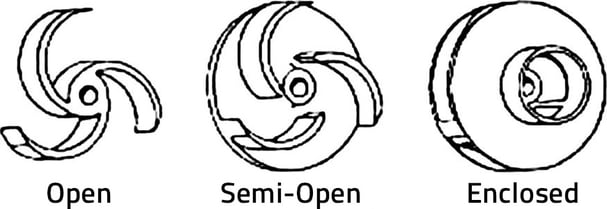
There are three different types of impellers; open, closed, and semi-closed. Each has its own strengths and weaknesses, depending on the application. Some are better for solids handling, others are better for high efficiency. To learn more about the specifics of each type of impeller.
Centrifugal pump impellers are selected with purpose and are dependent upon the application. Some are better for solids handling, others are better for high efficiency. Read on to find out which impeller will be best for your centrifugal pump application.
Open Impeller
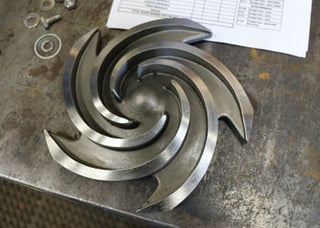
An open impeller has vanes that are attached to a center hub and mounted directly onto a shaft. There is no wall surrounding the vanes which makes open impellers weaker than closed or semi-closed valves.
Open impellers are generally faster and easier to clean and repair. Open impellers are usually used in smaller pumps and pumps that handle suspended solids.
Semi-Closed Impeller
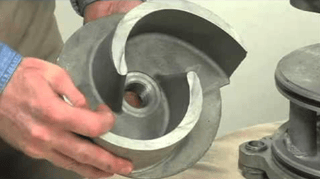
Semi-Closed impellers have a back wall that adds strength to the impeller. Semi-closed impellers are usually used with liquids or products that have solids. Reduced efficiency is a common problem with semi-closed impellers, but the ability to pass solids is an important trade-off.
Closed Impellers
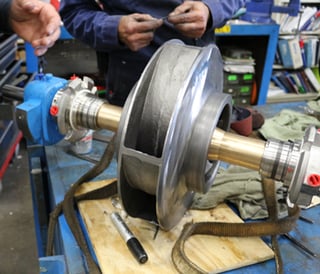
Closed impellers have a back and front wall around the vanes, to increase strength. Closed impellers are used primarily in larger pumps and can be used in applications that handle suspended-solid service.
These types of impellers are commonly found in clear liquid applications. They don't do well with solids and are difficult to clean if they become clogged.
Still not sure which impeller will be best for your next pumping application? Be sure to check wtih an application engineer who is well versed in pumps and selection best practices.
